Anyone seeking to know how to install an electrical distribution panel must also be interested in the regulations in force in their country: NFC 100-15 for France, General Regulations on
Electrical Installations (RGIE) for Belgium, SN 411 000 in Switzerland, etc.
Indeed, each country has its own regulations regarding mandatory standards for electrical installations. These standards may concern the type of equipment permitted or prohibited, its size, as well as the maximum number of circuits that can be connected to a row of the electrical panel, or even to a circuit breaker, depending on its type.
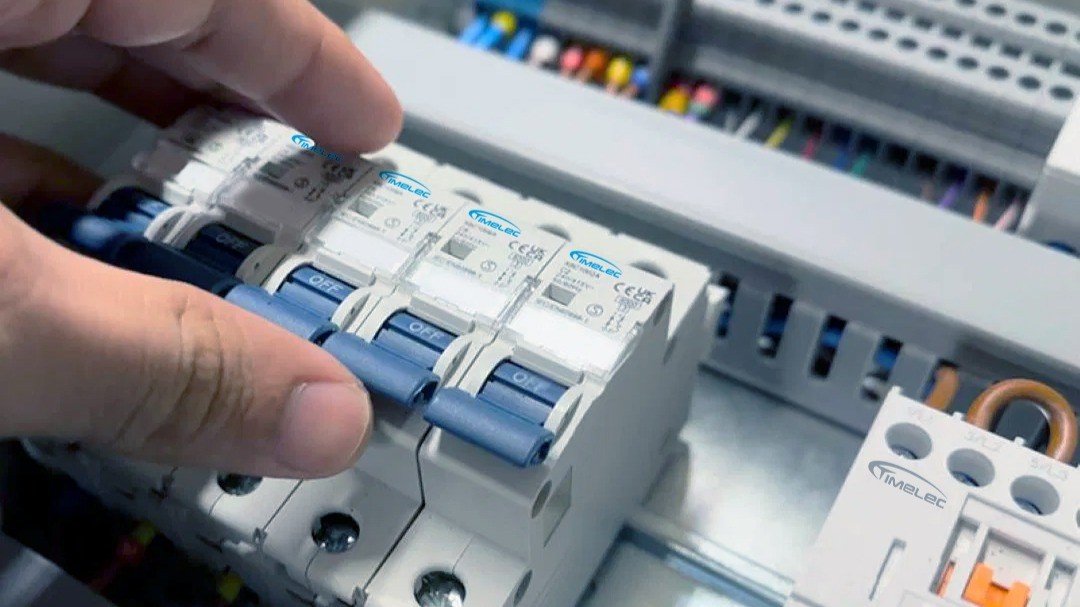
There are several types of circuit breakers, each determining its use (main breaker, branch breaker, etc.) and the maximum electrical power rating for each breaker. Naturally, all of this defines the electrical diagram of the installation, and some circuit optimizations are sometimes necessary to wire all the electrical appliances in the home. Let’s take a closer look at the distribution of circuit breakers in an electrical panel.
What is an electrical distribution panel?
While it may seem obvious to many of us, let’s remember what an electrical distribution panel is. As its name suggests, it manages the entire electrical network of a home. But more than that, it protects electrical equipment and people from any electrical faults. It’s also important to know that one in four house fires is of electrical origin, linked to:
- the malfunction of a device (overheating);
- electrical risks ( overvoltage or short circuit);
- lightning (with the installation of a lightning arrester);
- etc.
Thus, each electrical appliance is connected to the distribution board, either via a shared circuit (grouping several devices) or a dedicated circuit, as is the case for an electric oven. In addition to obvious appliances such as a cooktop, washing machine, or heat pump, each group of electrical outlets, each lighting system, and each roller shutter must be connected to the electrical distribution board.
Fortunately, it is therefore possible to create shared circuits, such as grouping all the electrical outlets in a kitchen into a single circuit. However, certain rules must be known, or at least verified by reading the regulation.
But first, we need to look at the different elements that make up an electrical panel, since the distribution of circuit breakers is inherent to it.
What are the components of an electrical panel?
The electrical panel, or distribution board, is therefore the heart of the electrical installation. Electricity for the home arrives at the panel from the electricity meter and is then distributed to each electrical circuit in the house. To achieve this, the distribution board consists of several components:
- a main circuit breaker, also known as a branch circuit breaker, with a sensitivity of 300 mA (RGIE) to manage the general electricity of the dwelling;
- 30 mA residual current circuit breakers (or differential switches), placed at the beginning of each row of the panel, to automatically cut off the electrical current in case of an electrical “leak” (“differential” for the difference between the intensity of the phase and the neutral, or, to simplify, between the input and output current);
- branch circuit breakers for the protection of electrical property (group of sockets, switches, lighting, electrical appliances, etc.);
- a lightning rod to protect electrical and telephone lines in case of lightning striking the dwelling;
- additional modules as needed (such as a programmable clock, a day/night contactor, a load shedding device, etc.).
While the main circuit breaker and residual current devices (RCDs) protect people (and therefore electrical appliances), branch circuit breakers protect electrical equipment. This is why branch circuit breakers have a variable capacity depending on the needs and the connected electrical circuit, thus requiring their proper distribution.
How to install circuit breakers in an electrical panel according to the standard?
To comply with the RGIE (General Regulations for Electrical Installations), grounding the electrical panel is mandatory for obvious safety reasons. Then, as we have seen, the branch circuit breakers must be selected and distributed according to their variable capacity.
In most cases, professional electricians distribute branch circuit breakers according to their use. Thus, one row is reserved for lighting (low voltage), one row for electrical outlets (high voltage), etc.
Installing an electrical panel (especially connecting the circuits) is not complicated and requires no in-depth knowledge. To know how to distribute the circuit breakers, simply follow the general rules of the RGIE (General Regulations for Electrical Installations), the main points of which are outlined below:
- The lighting circuit must be connected to a 16 A branch circuit breaker for a wire cross-section of 1.5 mm²;
- The electrical outlet circuit uses a 20 A branch circuit breaker and a wire cross-section of 2.5 mm².
- The dedicated or specialized circuit (i.e., a single circuit for each high-power electrical appliance, such as the washing machine, oven, heat pump, etc.) requires a 20 A circuit breaker; the wire cross-section depends on the electrical appliance connected.
- The cooking circuit (hob) must be connected to a 40 A differential circuit breaker for a wire cross-section of 6 mm²;
- The heating circuit is limited to several radiators (maximum 4,500 W) and must be connected to a 20 A circuit breaker for a wire cross-section of 2.5 mm².
It’s also important to know that the number of devices on a circuit is limited: 8 light points or 5 to 8 roller shutters, depending on the circuit breaker (10 A or 16 A). This also applies to sockets: a maximum of 8 sockets (knowing that a single socket = 1 socket, a double socket = 1 socket, a triple socket = 2 sockets,s and a quadruple socket = 2 sockets).
Note that some electrical appliances are more or less sensitive to fluctuations, such as mechanical ventilation systems (MVHR). In such cases, it is essential to follow the manufacturer’s recommendations, such as using a 2A residual current circuit breaker.
Properly distributing circuit breakers in your electrical panel doesn’t require any special knowledge, other than carefully reading the applicable standards in the country where the property is located (RGIE, NFC 100-15, etc.). The regulations are easy to understand and particularly well-written, allowing everyone to grasp the general rules.
Next, you need to be logical with your electrical installation and keep things simple when running the cables. For example, it can be less work to create two separate circuits for two radiators whose combined power does not exceed 4,500 W, but which are located on opposite sides (and therefore run two cables) rather than running one cable between the two electrical appliances.
Finally, it’s worth noting that ready-to-use installation kits are available, tailored to specific needs (length of electrical conduits, number and power rating of various circuit breakers, custom electrical diagrams, etc.). These solutions offer significant time savings.